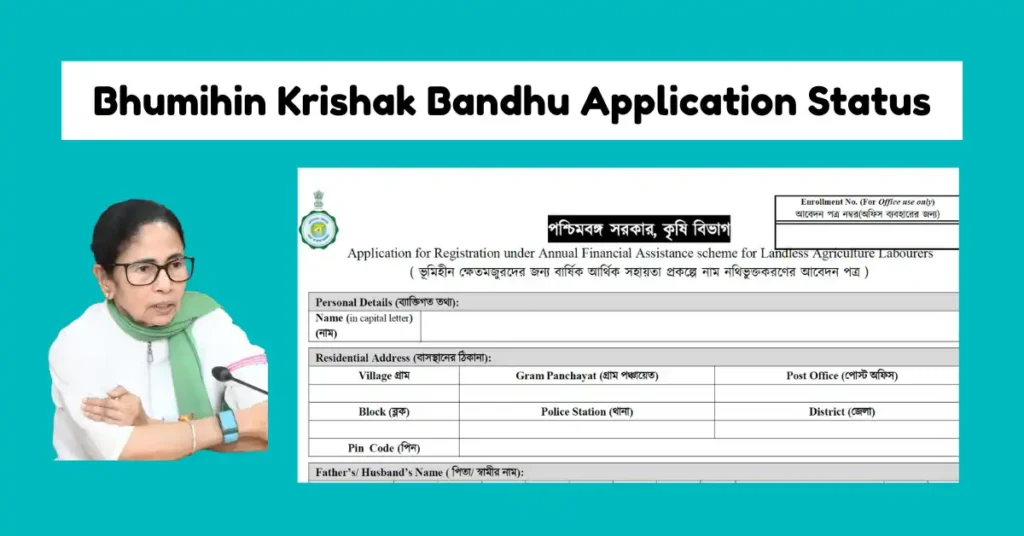
The Government of West Bengal continues to expand social security coverage for agricultural workers through the Bhumihin Krishak (Landless Farmer) Assistance Programme, linked with the broader Krishak Bandhu initiative. Thousands of landless agricultural labourers who have applied for financial assistance can now check their application status online from home.
What is the Bhumihin Krishak Bandhu Scheme?
The Bhumihin Krishak programme is designed for landless agricultural labourers who are not eligible under traditional farmer income schemes due to lack of land ownership. The initiative aims to provide direct financial support and include vulnerable rural workers within the state’s welfare network.
Under the expanded policy announced in the state budget, eligible landless workers will receive ₹4,000 annual assistance, distributed in two seasonal instalments.
Financial Support Structure
- ₹2,000 during the Rabi season
- ₹2,000 during the Kharif season
- Total yearly benefit: ₹4,000
- Amount transferred directly through DBT (Direct Bank Transfer)
This support complements the larger Krishak Bandhu Scheme, which already provides income support and insurance protection to registered farmers across West Bengal.
Why Online Status Checking Matters
Many applicants submit forms through camps, agricultural offices, or online portals. The new digital system allows beneficiaries to verify whether:
- Application has been entered into the government database
- Registration is completed successfully
- Form is approved or pending verification
- Payment eligibility is confirmed
Applicants can now track approval without visiting government offices.
How to Check Bhumihin Krishak Status Online (Step-by-Step)
Follow these simple steps:
- Visit the official Agricultural Labour Portal or Matir Katha agriculture portal.
- Select the Agricultural Labour / Bhumihin Krishak section.
- Click “Know Your Application Status.”
- Enter any one of the following:
- Registered Mobile Number
- Aadhaar Number
- Click Search.
- Your application details and status will appear on the screen.
If the application shows “Quick Registration,” it means the form has been entered into the system. Once verification is completed, the status changes to “Approved.”
Who is Eligible?
The scheme primarily targets economically vulnerable agricultural workers.
Basic Eligibility Conditions
- Must be a resident of West Bengal
- Should be a landless agricultural labourer
- Must be actively engaged in farming-related work
- Valid Aadhaar-linked bank account required for DBT transfer
The broader Krishak Bandhu framework also includes farmers and sharecroppers to ensure wider agricultural welfare coverage.
Difference Between Krishak Bandhu & Bhumihin Krishak Support
| Scheme | Beneficiaries | Annual Assistance |
|---|---|---|
| Krishak Bandhu | Land-owning farmers | Up to ₹10,000 yearly |
| Small/Marginal Farmers | Less than 1 acre land | Minimum ₹4,000 |
| Bhumihin Krishak | Landless labourers | ₹4,000 yearly |
The state government introduced this extension so that agricultural workers without land ownership are not excluded from financial protection programmes.
Payment Process
After approval:
- Beneficiary details are verified by the agriculture department.
- Funds are transferred directly to the bank account.
- Payments are released twice annually during crop seasons.
Season-based payments align with farming cycles to help workers manage livelihood expenses.
Common Status Messages Explained
| Status | Meaning |
|---|---|
| Quick Registration | Application entered but verification pending |
| Under Process | Documents under review |
| Approved | Eligible for payment |
| Rejected | Information mismatch or ineligible |
Applicants should ensure mobile numbers and Aadhaar details are correct to avoid delays.
Importance of the Scheme in 2026
Agricultural labourers often depend on seasonal income and lack financial stability. By extending direct cash support to landless workers, the West Bengal government aims to strengthen rural economic security and widen agricultural welfare coverage.
The initiative also helps build a verified database of landless farm workers for future benefits and social protection programmes.